"If God is the center of your life, no words are necessary. Your mere presence will touch hearts."
Saint Vincent de Paul
Celebrated by the Catholic Church on the 27th of September, Saint Vincent is recognized across the world as the patron saint of charity, but here in Northeast Ohio, he is the patron saint of our parish.
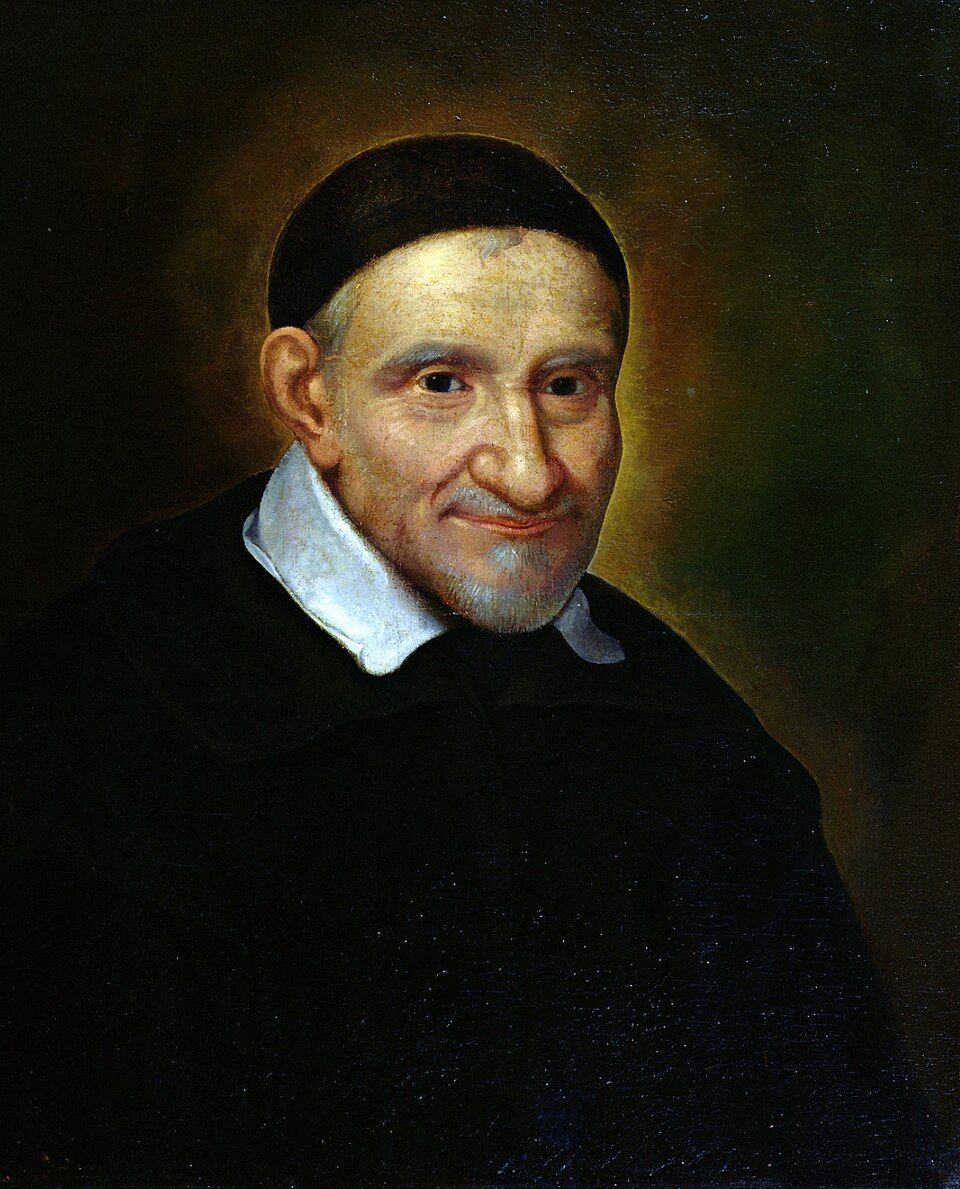
Life and Works
In April of 1581, Vincent de Paul was born in a village in southern France to Jean de Paul and Bertrande de Moras. Despite growing up in a hard-labor environment on his family's farm, the young Vincent set himself apart from his siblings with his literary talents.
At 15, Vincent's parents made good on their son's advanced literacy by enrolling him in a seminary. He developed a storied academic career. His first years in theological academia kept him in France, where he paid for tuition through tutoring and by securing patrons. At 19, he was briefly ordained as a priest before resigning, as his ordination contradicted the standards set by the Council of Trent. Returning to his studies, Vincent graduated with a Bachelor's in Theology.
According to Vincent's writings, his academic career was put on hold again when Barbary corsairs abducted him while sailing off the coast of southern France. These corsairs took him to a region of the Ottoman Empire, where he was sold into slavery. After two years, he would escape back to Europe after convincing a former priest-turned-Muslim slave owner to convert back to Catholicism and set him free.
After returning to Europe, Vincent traveled to Rome, where he completed his education and would once again join the priesthood. The Clergy would send him back to France, where he would spend several years as a parish priest, chaplain, and tutor for the wealthy and noble families. His exploits would eventually see him in Paris, where he would experience a paradigm shift.
One day, he was chosen to hear the last confession of a dying peasant. While the contents of this interaction are unknown, it seemed to be a turning point for the priest, after which he began serving poor families and helping to found the Confraternities of Charity to fund missionary projects, hospitals, and efforts to free slaves in North Africa. He also founded The Congregation of the Mission, an order of priests dedicated to serving the people of small and impoverished villages exclusively.
Later in life, he would form ties with the royal family of France and would serve as Queen Anne's spiritual adviser when she served as Regent.
He would continue his work until he died in 1660.

Journey to Sainthood
The process for his sainthood began in 1697, 37 years after his death. The Clergy recognized his life of extraordinary service to the church, but procedure demanded evidence of at least 2 posthumous miracles attributed to him.
In the late 1720s, a nun struggling with severe ulcers reported a miraculous recovery that showed signs of the then-candidate's intercession. Soon after, a woman suffering from paralysis reported a similar recovery. These reports satisfied the conditions for further consideration, and Pope Benedict XIII declared him Blessed in 1729.
After 8 years of further consideration, Pope Clement XII officially canonized him. He would then be known as St. Vincent de Paul

Veneration in Modern Times
Today, Saint Vincent de Paul is recognized as the Patron Saint of charity, the marginalized, hospitals, and many more.
We celebrated his feast day on September 27th, the date of his passing.
Several parishes and charitable organizations get their name from the Saint. One such organization is The Society of St. Vincent, started in 1833; the society continues today and assists the poor in 153 countries.
In his September 2010 Angelus address, Pope Benedict XVI noted that St. Vincent “keenly perceived the strong contrast between the richest and the poorest of people,” and was “encouraged by the love of Christ” to “organize permanent forms of service” to provide for those in need.